Embedded Systems & Firmware Engineering Intern
Location: Cambridge, MA
Duration: Spring or Summer 2027 (10+ weeks)
About OrthoIQ
OrthoIQ is an MIT-founded medical technology startup developing intelligent surgical tools for orthopedic procedures. Our systems provide real-time sensing and feedback to surgeons, helping improve implant fixation, reduce complications, and improve surgical outcomes.
We are building a new class of smart orthopedic instrumentation, combining mechanical systems, sensing, and data to bring intelligence into the operating room.
Role Overview
We are seeking an Embedded Systems & Firmware Engineering Intern to help develop the embedded electronics and control systems behind our next-generation orthopedic surgical tools.
This is a highly hands-on role where you will contribute to embedded hardware and firmware development, from system architecture and circuit design through prototyping, integration, and testing. Interns should expect significant technical ownership while collaborating closely with our engineering team on architecture and design reviews.
Responsibilities
Embedded electronics architecture and PCB design
MCU/processor evaluation and selection based on system requirements
Embedded C/C++ and real-time firmware development
Sensor interfaces, ADCs, signal conditioning, communications, and power electronics
Port validated signal-processing and detection algorithms onto embedded hardware
Develop real-time control and safety-critical system architectures
Motor/actuator control and hardware-software integration
Prototype, debug, test, and characterize embedded systems
Support design for reliability, EMC, power, thermal constraints, and medical-device development
Desired Qualifications
Pursuing or recently completed a BS/MS in Electrical Engineering, Computer Engineering, Robotics, or a related field
Experience with microcontrollers and embedded systems
Experience with embedded C/C++
Familiarity with circuit design and PCB development
Experience with sensors, ADCs, motors, or control systems preferred
Hands-on experience with oscilloscopes, logic analyzers, soldering, and hardware debugging
Comfortable independently solving technical problems in an early-stage startup environment
What You'll Gain
Significant ownership of hardware that may progress toward clinical testing
Experience taking an embedded system from prototype through integrated medical-device development
Exposure to regulated and safety-critical product development
Experience working across electrical, mechanical, software, and clinical disciplines
Close collaboration with experienced engineers and orthopedic surgeons
Application:
Please apply through Handshake for Spring and Summer 2027. A portfolio (doesn’t have to be polished, can even be a slide deck!) is required. We want to see pictures of what you’ve built!
What you’ll work on
Build the next generation of surgical hammers
Our main product is an orthopedic automatic hammer with an integrated sensor that tells the surgeon when to stop hammering. Right now they judge when to stop hammering based on feel, but overhammering can cause bone fractures and underhammering causes the implant to loosen over time.
Interns will help solve real engineering challenges in mechanism design, prototyping, component selection, thermal management, and reducing weight and recoil.
Help us integrate sensing/controls and prove reliability
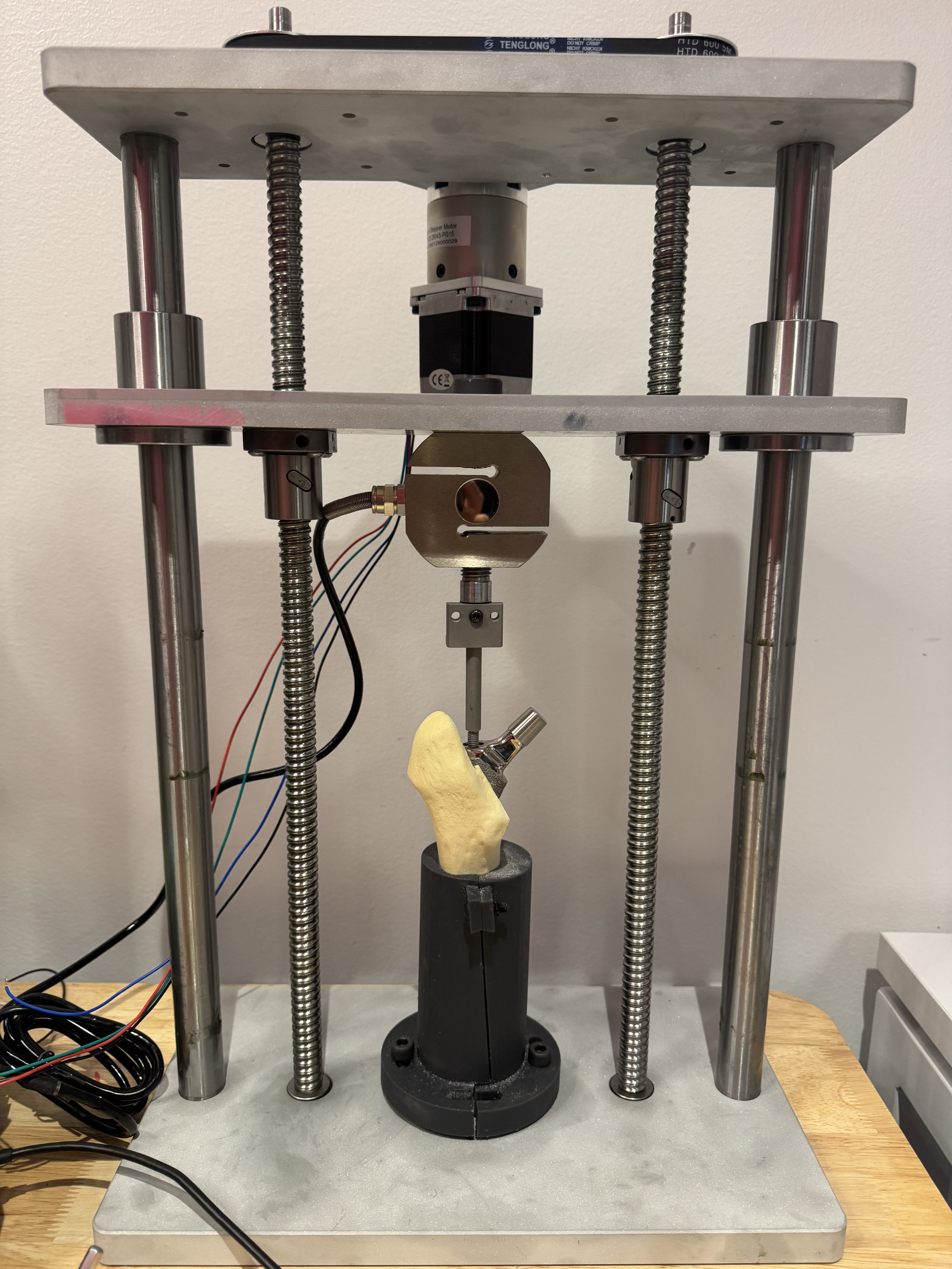
We’re integrating sensors to measure what happens during each impact and exploring whether those signals can identify when an implant has reached stable fixation. Interns may build test rigs and data-acquisition systems, run experiments, and analyze mechanical and sensor data.
Turn a prototype into a medical device
Surgical devices have to work reliably across different implants, bone conditions, loads, and repeated use. Our device must be manufacturable, sterilizable, reliable, serviceable, and intuitive to use in the operating room.
Interns will contribute to DFM/DFA, reliability and verification testing, design iteration, and the engineering decisions required to move from prototype to production.